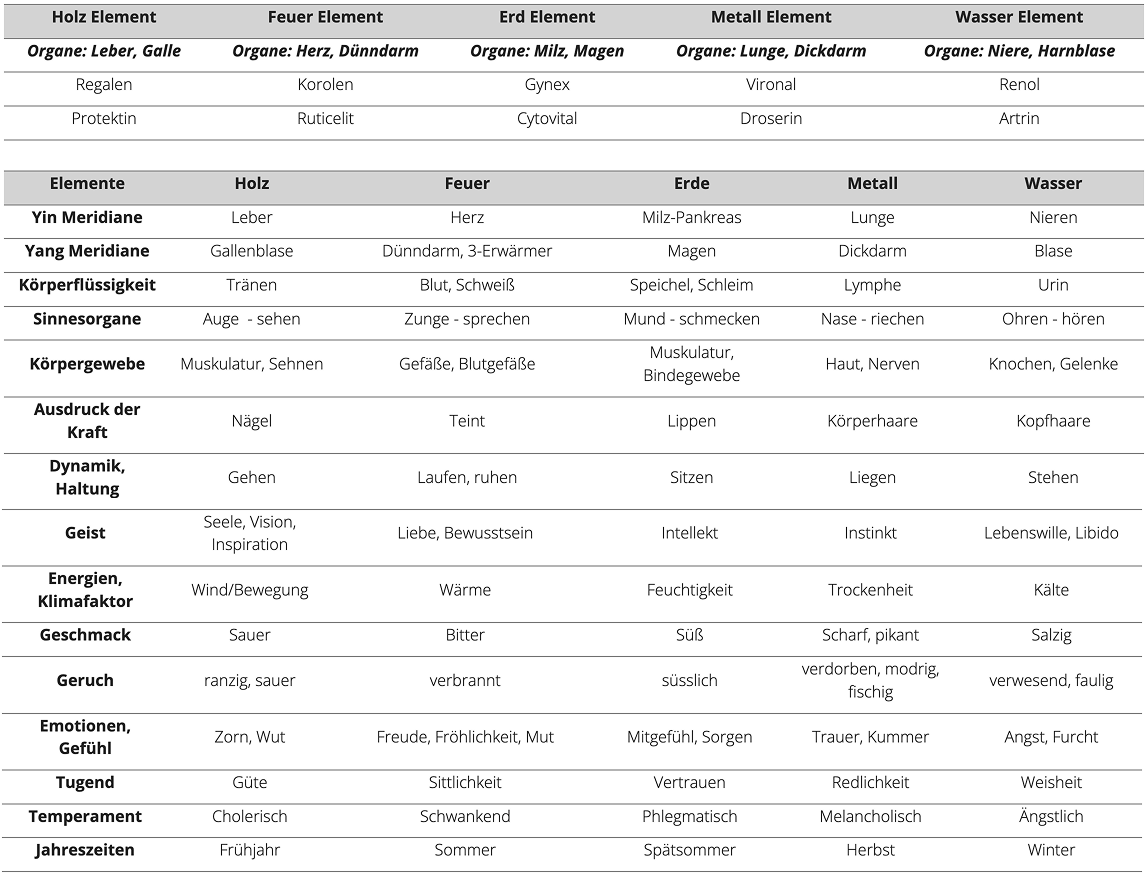



Organ clock
Brief Description
The organ clock illustrates the daily rhythm (each meridian is flooded with Qi for two hours a day), the relationships to the elements, the season, the associated meridians with organ/functional groups, and their corresponding aspects. This allows for easy identification of disharmonies related to a specific time of day. For example, disharmonies related to a specific time – the liver meridian has its most intense energy between 1:00 and 3:00 a.m. – can then be clearly read. If sleep disturbances occur during this time, for instance, the connection to the liver – meridian/organ and also the coupled meridian/organ, in this case, the gallbladder, can be easily identified.
Origin & Principle
The principle of the organ clock originates from Traditional Chinese Medicine (TCM). It posits an energy cycle in the human body that follows the exact same pattern daily and extends throughout the entire human organ system. The organ clock, therefore, operates on the assumption that within this energy cycle, each organ has so-called minimal and maximal times.
Meridians & Organ Clock
According to TCM (Traditional Chinese Medicine) theory, so-called meridians run through the body, each assigned to an organ. There are thus twelve main meridians in the human body. These meridians transport the life energy Qi. An adequate flow of Qi is crucial for becoming and staying healthy. If not enough life energy flows through the meridians, meaning a harmonious Qi flow is not possible, damage to the respective organs can occur.

Application, Biorhythm & Energy Cycle
The organ clock starts at 3 am with the maximum time of the lungs, followed by the maximum times of the other organs at two-hour intervals. Their sequence follows the teachings of classical acupuncture: after the lungs comes the large intestine, then stomach, spleen-pancreas, heart, small intestine, bladder, kidney, pericardium (circulation), triple warmer, gallbladder, and finally, from 1 am to 3 am, the liver.
But what is the purpose of the organ clock? What good does it do to know when which organ has what performance capacity? It can help the naturopath in diagnosis. Especially when the patient complains about the same symptoms at the same times. Then looking at the organ clock makes a lot of sense, as it can significantly narrow down the causes. The therapist can then recognize which organ system has a disturbance based on the improvement of symptoms at the maximum time or the worsening at the minimum time.
An important side effect of the temporal limitation is that medications can be administered more effectively and promptly in relation to the respective organ. Since some of the minimum times are also at night, the therapist may have to pay attention to recurring waking times of the patient.
An example: What happens between 3 and 5 am in the body?
Between 3 and 4 am, the sleep hormone melatonin is released, which causes people to sleep very deeply again. Between 4 and 5 am, the organism slowly prepares for waking up - blood pressure rises. The most common complaints with an insufficiently regenerated - i.e., disturbed - lung are heart weakness, shortness of breath, chills, sore throat, and a feeling of pressure on the chest. People who suffer from asthma, for example, experience the most frequent attacks at this time.